How Mondelez’s R&D Chief Avoids the 'Overwhelm' of Tech Innovation, Trend Noise

Editor's Note: This article is part of a CGT series that digs into leadership hires a year into the new positions, to learn how roles are evolving and how fresh eyes can transform business operations.
Norberto Chaclin has held the title of EVP and chief R&D officer for Mondelez International for just over a year. His time at Mondelez, which spans eight years, has been a striking difference from his last company, where he worked across Pepsi's North America portfolio.
Working just across the regional unit brought its own challenges and opportunities, and it was easy to get caught up in the adrenaline of running that business from the inside, he says. And when he transitioned to this global role at Mondelez, it required a bit of reflection "to elevate up."
"You're less busy on a minute-by-minute basis, but the things you're pondering are of bigger strategic significance, larger dollar values or more difficult decisions," Chaclin tells CGT. "The point is, I need to think about the future and make sure we have the right strategy so that my team can run the day-to-day."
While the global lens is important, there's always tension between central corporate functions and local business, and tension between functions like R&D and commercial businesses, he says.
His approach to this is to first understand where commercial partners are coming from, spending time with business unit presidents to understand what's working and what's not from an R&D perspective. And then he reconciles that with the objectives that have trickled down from the C-suite.
"Within Mondelez, it's pretty transparent what R&D works on globally, even the things that are not business-unit specific. We try to be very transparent about what we're doing so that everyone understands how we're making priorities," he says.
All the while, Chaclin is working to establish some ground rules for tech-enabled R&D that supports these objectives while advancing the company's goal of becoming a more digitalized business.
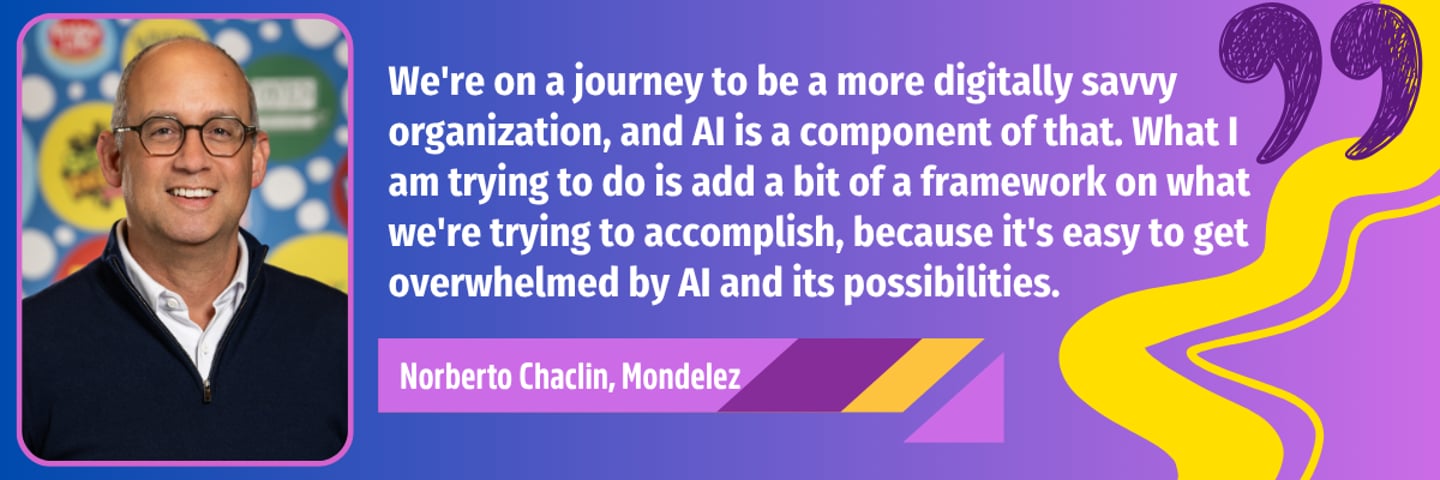
"We're on a journey to be a more digitally savvy organization, and AI is a component of that," says Chaclin. "What I am trying to do is add a bit of a framework on what we're trying to accomplish, because it's easy to get overwhelmed by AI and its possibilities."
Zooming Out to Gain Clarity
Chaclin says there's a tendency to sometimes jump to the more complicated solution because it's the more exciting one. Oftentimes, however, there's a much simpler path to take.
This is why Chaclin targets the "low hanging fruit," asking himself, "where do we really have the biggest opportunity in R&D to use AI to do our job better or more efficiently?"
If he can get the heavy lifting done with AI, he says, then he leaves room for "the talented people on the team to work on the more difficult projects."
Also: Mondelez CTO Christopher Hesse was named a 2025 CGT Visionary
Right now, he's considering whether time-intensive processes around consumer research and individual consumer tests can be optimized with AI, but the conversations are still in the early stages.
"There's a bit of a way to go to do that, but that is one element. There's a lot of product testing that we do to scale something up from the lab to a large factory," he says.
Additionally, he's looking at data efforts, searching for ways to improve decision-making through AI solutions that can aggregate insights into improved "buckets" and create new efficiencies for the organization.
Supply Chain Basics and Trend-Spotting
While tech innovation is often the shiny object that enterprises love to focus on, Chaclin says the area his team most focuses on is the supply chain: improvements, ingredient substitutions, disruptions, etc.
The last five years, in particular, have been extremely disruptive for businesses, he says.
"The other thing we do a lot is look at process improvement. The best way to optimize your organization and optimize your cost is to make your process more efficient," he says.
Part of this has been to respond to a recent shift in regulations, requiring Mondelez to look at compliance for its products, which often depends on the local markets. The company then has to determine how that will impact the consumer.
While he says it's a very academic process from a regulatory standpoint (if X changes, then the label has to change, etc.), there's often an emotional attachment when it comes to consumers as it might be tied to a trend like mindful snacking.
"And that is a much more nuanced shift. Different groups of consumers respond differently to health and wellness. So there's a couple of foundational shifts."
Regulations might call for simpler, dye-free ingredients, while some consumers want nutritionally improved products and others want enhancements like added protein and fiber. Chaclin's team is tasked with navigating these needs and looking at how they might intersect.
"We know where consumers are going, and the trick is to then decide how to respond with different brands in different ways against those trends. Not every brand should add protein or fiber."
Even when consumer trends don't tie into regulation, it can be just as tricky. Because it takes time to mobilize on a trend, Chaclin has to be very strategic about how/when to act on mass consumer interest.
"The trick becomes which of those trends are going to stick, and which are just transient?" he poses. "We're trying to connect trends to major product platforms in the business, so that we can be a bit more coordinated on where we are planning to tap into trends as they emerge and where we are not."
Otherwise, companies would simply "boil the ocean" because there's just so much coming their way, trend-wise, he adds.
Going in With a Collaborative Mindset
Chaclin is well aware that innovation doesn't happen in silos. He's focused on running an R&D organization that is well-connected cross-functionally and is seen as a partner at the table.
He has also set this expectation on his team, ensuring that efforts are aligned between R&D and commercial teams, marketing, sales and especially with the global manufacturing organization.
"We are the link between the two, and we have to be really closely connected to both understand what the challenges are that they are solving and how we can efficiently provide solutions commercially to keep the lights on while driving innovation."