Redefining Retail Execution as a Competitive Edge

Retail execution is nearly indistinguishable from just a few years ago. No longer are efforts solely manual, and stronger data and analytics practices have elevated insight gathering and decision-making. This paired with technology has created a truly optimized, future-proof business process that improves inventory accuracy and reduces timely, laborious tasks.
Cait Will, chief revenue officer for Repsly, shares details about the current state of retail execution and how consumer goods companies are having to redefine their processes to maintain their competitive edge.
CGT: When addressing the disconnect between back-office ERP records and "phantom inventory" on the shelf, what are the most effective strategies for consolidating fragmented data sources into a single, real-time command center that field reps can actually use?
Cait Will: The instinct is often to fix ERP data, but that’s not where the problem gets solved. Instead, complement the ERP data and gather additional data on real-time store intelligence via your field team to actualize the current state.
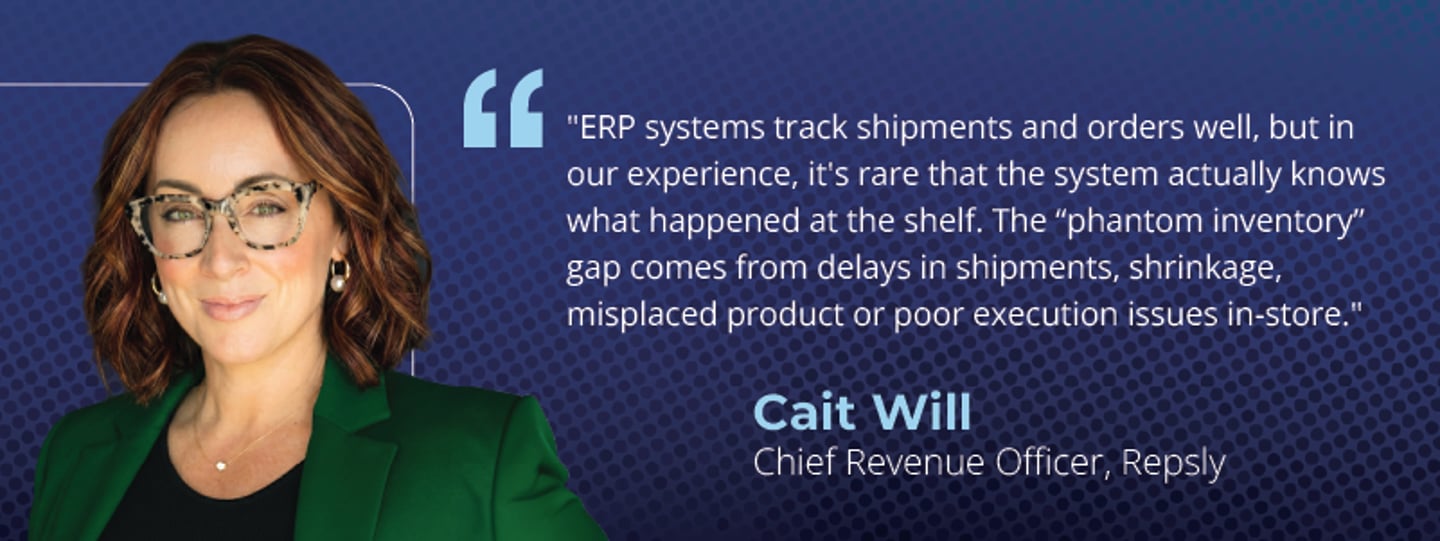
ERP systems track shipments and orders well, but in our experience, it's rare that the system actually knows what happened at the shelf. The “phantom inventory” gap comes from delays in shipments, shrinkage, misplaced product or poor execution issues in-store.
The solution is a closed-loop system back to the ERP. It pulls in the ERP data (or sales data) and aims to capture the reality at the shelf (via mobile audits, manual, or image recognition photo data and structured workflows), to reconcile the difference and solve the problem. That creates a true command center for field teams: a single view of expected vs. actual conditions, with clear next steps.
Instead of asking reps to interpret disconnected systems, you guide them by triggering alerts, tasks or reorders based on real-world discrepancies. That’s how you move from fragmented data to fast, in-store action.
CGT: As CPGs move away from manual, monthly audit cycles and toward automated, data-enabled practices, how are field teams shifting their focus toward retailer advocacy and store-level growth rather than task management?
Will: As field teams move away from manual audits and toward data-driven execution, their role fundamentally shifts.
When reps are guided by real-time data — ERP, POS and store-level signals — they stop spending time on routine visits and start focusing on the stores that actually need attention.
That’s where the shift to retailer advocacy happens. Reps aren’t just completing tasks, they’re showing up with context, insight and a clearer purpose.
A great example: one of our dairy customers launches a new SKU and is monitoring daily sales. In a handful of stores, sales were coming in at zero — even though the new product was part of a key promotion at that retailer, expected to generate around $2,000 per store, per week. That custom report showing SKUs with zero sales puts the right stores on their schedule for the day, armed with the data they need to make a real impact when they arrive.
Instead of a routine audit or visit, it’s a collaborative, solution-focused conversation that benefits both sides.
CGT: How can veteran field teams transition from "gut-feeling" decision-making to a collaborative model where they work alongside AI-driven recommendations and autonomous replenishment systems?
Will: The change or shift isn’t about replacing this critical experience; it’s about augmenting it with better signals to put their talent to work, even more aggressively.
Veteran field teams have deep intuition built over years in-store. The goal should be to pair that know-how and intuition with AI that can surface patterns they can’t see at scale — like subtle demand shifts, coverage gaps creeping in or recurring execution issues that tell a larger story.
The most effective leaders and teams position AI as a co-pilot or partner, not a controller:
- AI identifies where attention is needed, and might rank it by impact
- Reps apply their judgment on how to act
- The results feed back into the system to continuously improve and scale smart recommendations
We’re trialing an AI "co-pilot" with our customers to help territory managers plan. A real-life scenario today, with gas prices rising 30%-plus and creating true cost impact, would be a prompt like, “What if we rebalance our territories for travel time vs coverage?”
This type of work doesn’t replace a seasoned veteran’s know-how — it's now become a collaborative loop where human experience and data reinforce each other, rather than compete or replace.
CGT: Looking toward the rise of agentic commerce, what benchmarks should CPG brands be setting today to quantify the impact of real-time execution on long-term market share and trade spend efficiency?
Will: The thesis is that the shift to agentic commerce raises the bar. Execution doesn’t just influence shoppers anymore, it influences how AI systems decide what gets recommended, prioritized and re-ordered, if applicable.
Brands should start defining benchmarks not just as KPIs, but as performance thresholds for winning, both at the shelf and within AI-driven systems.
Some indicating KPIs that brands should really start tracking include:
- On-shelf availability in as near real time as possible
- Time-to-resolution for out-of-stocks
- Execution compliance during key promotional windows
- Sales velocity during execution — perfect vs. execution-broken conditions
From here, they may start to compare KPIs like:
- Sales lift in “execution-perfect” stores vs. others
- Promo ROI variance based on execution quality
- Incremental revenue recovered from fixing OOS or misexecution
These metrics don’t just reflect performance; they’re signals that will increasingly inform how products are surfaced and prioritized in an agent-driven environment. This is where trade spend efficiency becomes measurable.