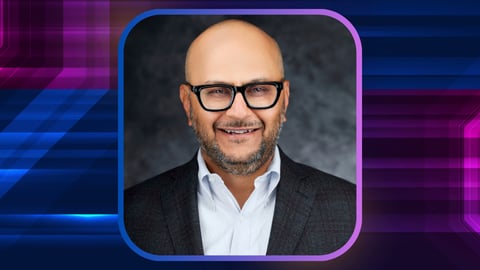
How Hershey CIO Gene Kholodenko Leads Future-Proof IT Strategy


Editor's Note: This article is a part of a CGT series that digs into leadership hires a year into the new positions, to learn how roles are evolving and how fresh eyes can transform business operations.
The Hershey Co. has been on a multi-year journey to modernize its technology infrastructure through IT acceleration and a digital-first mindset. Just over a year ago, the company appointed Gene Kholodenko as its CIO to lead these efforts.
"My appointment marked a pivotal step in advancing Hershey’s data-driven decision-making and scalable tech solutions," he tells CGT. He was tasked with embracing technology as a way to focus on high-value, strategic work and support the company's goal of becoming a multi-category snacking leader through innovation.
Kholodenko was hired for his more than 26 years of experience in IT and digital and business transformation leadership, bringing a track record of leveraging technology across sales, marketing, R&D, supply chain and manufacturing.
He previously spent more than two decades at Procter & Gamble, working in IT, CTO and CIO roles across the company’s home care, fragrances, chemical and global businesses.
Since taking on the role last October, Kholodenko has worked closely with the company's first CTO, Deepak Bhatia, who was hired in 2023. Together, the roles function as a strategic lever to accelerate Hershey's digital modernization in a variety of ways, including faster data-driven decision-making, new cost efficiencies, improved risk management, workforce upskilling and external IT partnerships.

Getting Data Up to Speed
Kholodenko has helped oversee the move to unified analytics and cloud-based solutions since joining. This includes a migration to SAP S/4 HANA, which is the digital backbone of Hershey's operations and streamlines global processes across procurement, inventory and finance — and enables automation at scale.
Additionally, Hershey has been investing heavily in predictive analytics platforms to optimize its demand planning, trade spend and supply chain processes, using technology enabled by AI, digital twins and machine learning to allow for real-time adjustments of resource allocation.
Also: Hershey advances decision intelligence across the supply chain
"We have put the data-driven insights and the clarity and simplicity of next-best actions into the hands of our front-line workers in sales, marketing, supply chain and manufacturing to bring consumer-differentiated impacts to life faster," says Kholodenko.
These technologies are also accelerating the company's product development lifecycle, improving precision and efficiency in both R&D and manufacturing so Hershey can translate insights into actions and make near-instantaneous changes "when and where they matter" — to anticipate and respond to market trends and consumer preferences, he adds.

Tightening Up Protocols
Kholodenko has helped embed risk management into everyday business processes at the company, enabling more informed and intelligent decision-making across the enterprise.
It's an approach that is rooted in partnership, he says. Business leaders need to share accountability for risk, streamline decision-making and foster transparency.
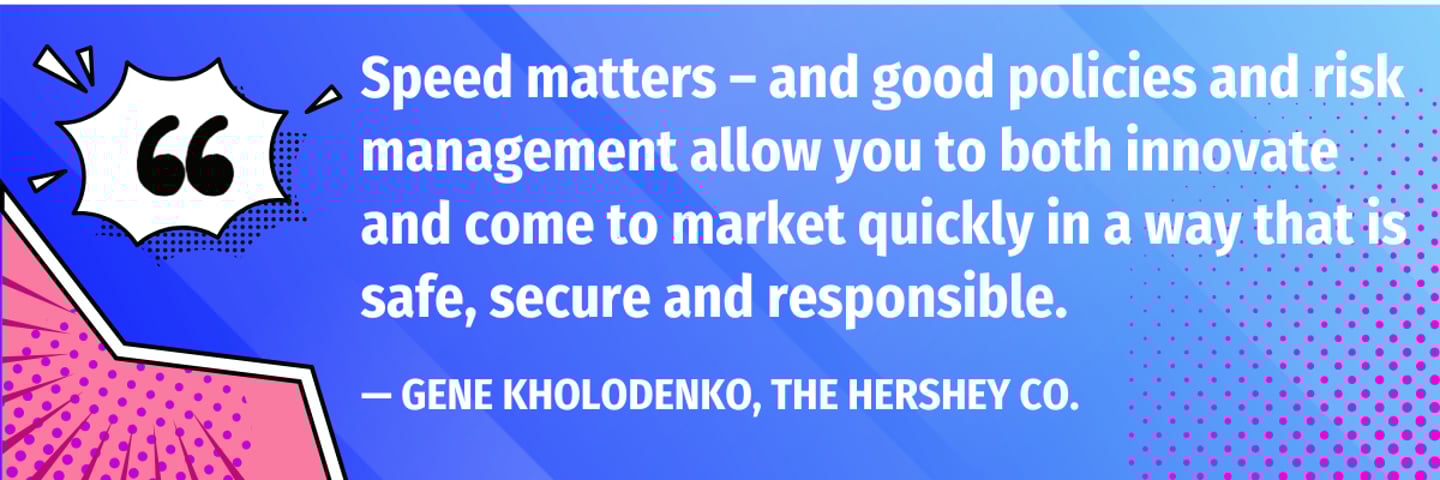
"This enables us to innovate confidently, always with consumer experience in mind," he says. "Speed matters – and good policies and risk management allow you to both innovate and come to market quickly in a way that is safe, secure and responsible."
Bringing the Team Along
Tech-enabled innovation doesn't work in silos; it's a cross-functional effort that requires investment in team members' skillsets.
"By embedding IT leaders within cross-functional teams and prioritizing shared outcomes focused on business strategy, we shifted IS from being a support function to a proactive value-creating business partner, driving strong collaboration and mutual accountability," he says.
For this reason, the company implements a strategy of ongoing upskilling to foster a culture of innovation, says Kholodenko. This includes education on AI and automation, continuous learning programs and digital benchmark training so teams are equipped for current and future challenges.
"By combining internal talent development with targeted hiring and external partnerships, we aim to ensure we have the expertise needed to drive digital transformation and maintain industry leadership," he says.
Forging Ahead
Hershey's path has been long and winding, requiring the company to first reduce its technical debt and embrace strategic platforms as it moved away from legacy systems.
It's a matter of striking a balance between customization to support unique products and markets, and scaling to optimize investments and accelerate value creation.
Kholodenko has fostered a culture of embracing fast failures and empowering IT teams to make decisions more easily by streamlining approval processes. Now, decision-making resides at the lowest responsible level, and by clarifying which decisions are reversible, the company has been able to accelerate timelines.
He is committed to strengthening business partnerships across Hershey and deepening the company’s digital mindset — ensuring that IT continues to enable growth, agility and innovation by equipping teams to harness technology, automate routine tasks and focus on strategic opportunities.
"The future roadmap centers on expanding and scaling our digital capabilities, fostering innovation, and strengthening data-driven decision-making," he says.