PepsiCo to Get Ahead of Supply Chain Challenges With 3D Digital Twin Tech

PepsiCo will revamp how it uses digital twin technology to transform operations within its supply chains.
The company announced during CES that it has partnered with Siemens and NVIDIA on early pilots in the U.S., using AI and new digital strategies to overhaul process simulation and facility design as part of efforts to "retool and optimize" its existing physical footprint.
PepsiCo sought out a solution that would overcome challenges related to more traditional supply chain expansion methods, which are often less flexible and more costly, and they don't meet scalability needs.
Real-Time Digital Twins
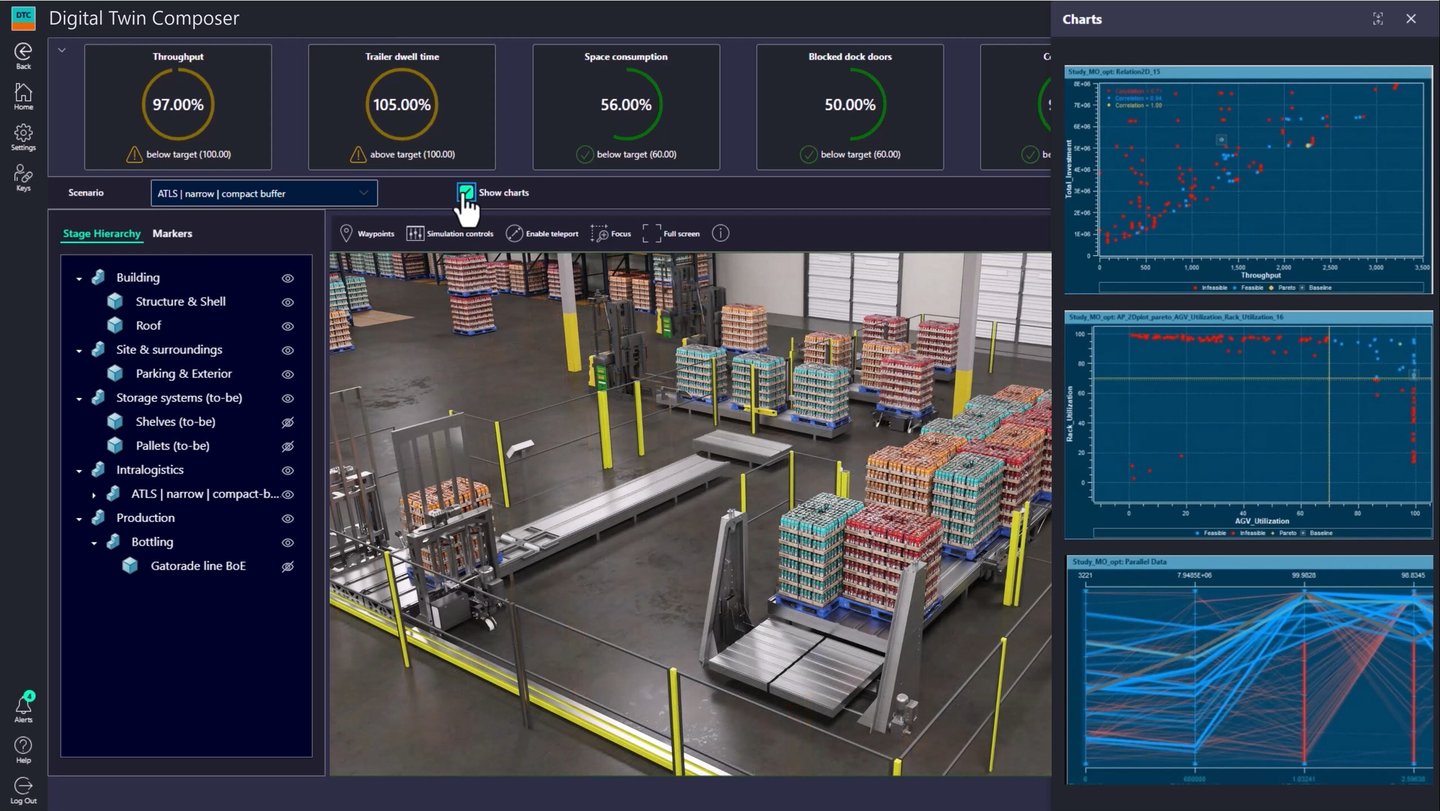
The company's move toward a digital-first planning strategy uses physics-based digital twin and AI technology, which will allow the tools to function as "co-designers" that can simulate, validate and optimize plant and warehousing facility layouts before moving on to building physical locations.
The partnership combines 2D and 3D digital twin data from Siemens’ digital twin and physical real-time information supported by NVIDIA computer vision-enabled Omniverse libraries. Through this, PepsiCo will recreate every machine, conveyor, pallet route and operator path in a digital setting, allowing AI agents to simulate, test and refine any changes.
Athina Kanioura, CEO, Latin America, and global chief strategy and transformation officer of PepsiCo, tells CGT that the approach is two-fold: One part for the new infrastructure the company plans to build (factories, warehouses, distribution centers, mixing centers, etc.) and the second for the optimization of existing facilities.
"It creates the layout, the optimization of the space, and the optimization of the hardware and software, including the navigation of the network across the board, in a simulated, optimized environment," she says. "We also have a lot of warehouses that are older, and they have to be able to navigate spikes in demand and different types of events."
In the past, when dealing with digital twins, companies were able to create scenarios, but the tech didn't reflect real-time inputs, says Kanioura. Now, the speed of execution is accelerated, and companies can use millions of parameters in a real-time nature to navigate any constraints, avoiding blind spots and optimizing supply chain planning.
The Benefits
PepsiCo is already reporting results, including a 20% increase in throughput upon the initial deployment, faster design cycles, nearly 100% design validation, and 10% to 15% reductions in capital expenditure due to uncovered increased capacity in the virtual environment. The company also expects to identify up to 90% of potential issues before requiring any physical fixes.
Once early testing in the U.S. is complete, the company plans to scale efforts globally, starting with its biggest markets (i.e., the U.S., Mexico, the U.K. and Western Europe) in 2026 and 2027.
"We are deploying the first digital blueprint that reimagines how the supply chain is designed, built and scaled — a first for the industry," Kanioura said in a statement.
"With a unified, AI-powered digital foundation, PepsiCo is building toward a world where every plant and warehouse operates as part of a single, intelligent ecosystem. In this future, our facilities don’t just respond to demand, they anticipate and then adapt to it," she added.